The Circumpunct at Planck Scale
Mathematical analogs for the fundamental "one" — replacing singularities
The circumpunct (⊙) symbolizes unity, origin, the fundamental "one". At the Planck scale (ℓ_P ≈ 1.616 × 10⁻³⁵ m), classical points/singularities break down into quantized states. No experiments probe this regime — all theoretical.
1. Spin Network States (Loop Quantum Gravity) ▼
Space as discrete spin networks: edges with SU(2) spins j_e, nodes with intertwiners.
Area: \(\hat{A}_S = 8\pi \gamma \ell_P^2 \sum_i \sqrt{j_i(j_i + 1)}\) (γ ≈ 0.2375)
Discrete, foamy geometry — no smooth points.

2. String/Brane Excitations (String / M-Theory) ▼
Points → extended strings/branes at ℓ_s ≈ ℓ_P.
Mass: \(M^2 = \frac{1}{\alpha'} (N + \tilde{N} - a)\) (α' ~ ℓ_P²)
Avoids singularities via extended objects.

3. Torsion-Dominated Geometry (Einstein–Cartan) ▼
Torsion from spin: \(T^\lambda_{\ \mu\nu} \propto S^\lambda_{\ \mu\nu}\)
Prevents point singularities via twisting at high density.

4. Planck-Star Core (LQG Phenomenology) ▼
Collapse bounces at Planck density → finite core, no singularity.
Modified Friedmann: \(\left(\frac{\dot{a}}{a}\right)^2 = \frac{8\pi G}{3} \rho \left(1 - \frac{\rho}{\rho_c}\right)\) (ρ_c ~ 0.41 ρ_P)
Interior finite; exterior black-hole-like.

5. Planck-Density Sphere — Core Replacing Black Hole Singularity ▼
In LQG-inspired models, gravitational collapse forms a finite core at Planck density ρ_P ≈ 5.155 × 10⁹⁶ kg/m³, where quantum repulsion halts compression. This Planck-density sphere replaces the infinite singularity at the black hole's center.
Planck density: \(\rho_P = \frac{c^5}{\hbar G^2} \approx 5.155 \times 10^{96}\,\mathrm{kg/m^3}\)
The event boundary immediately surrounding the sphere removes all quantum information (from the external observer's perspective, due to the information paradox and Hawking radiation). I.e., the sphere's boundary is the 2D quantum max — encoding maximum entropy/information per the holographic principle.
Bekenstein-Hawking entropy (on the 2D horizon): \(S = \frac{A}{4 \ell_P^2} = \frac{k_B c^3 A}{4 \hbar G}\), where A is the event horizon area.
This 2D surface holds the black hole's total quantum information, with the internal sphere's details "removed" or firewall-protected. The core radius scales with mass, but density caps at ρ_P — a bounded "dot" within the gravitational circle.
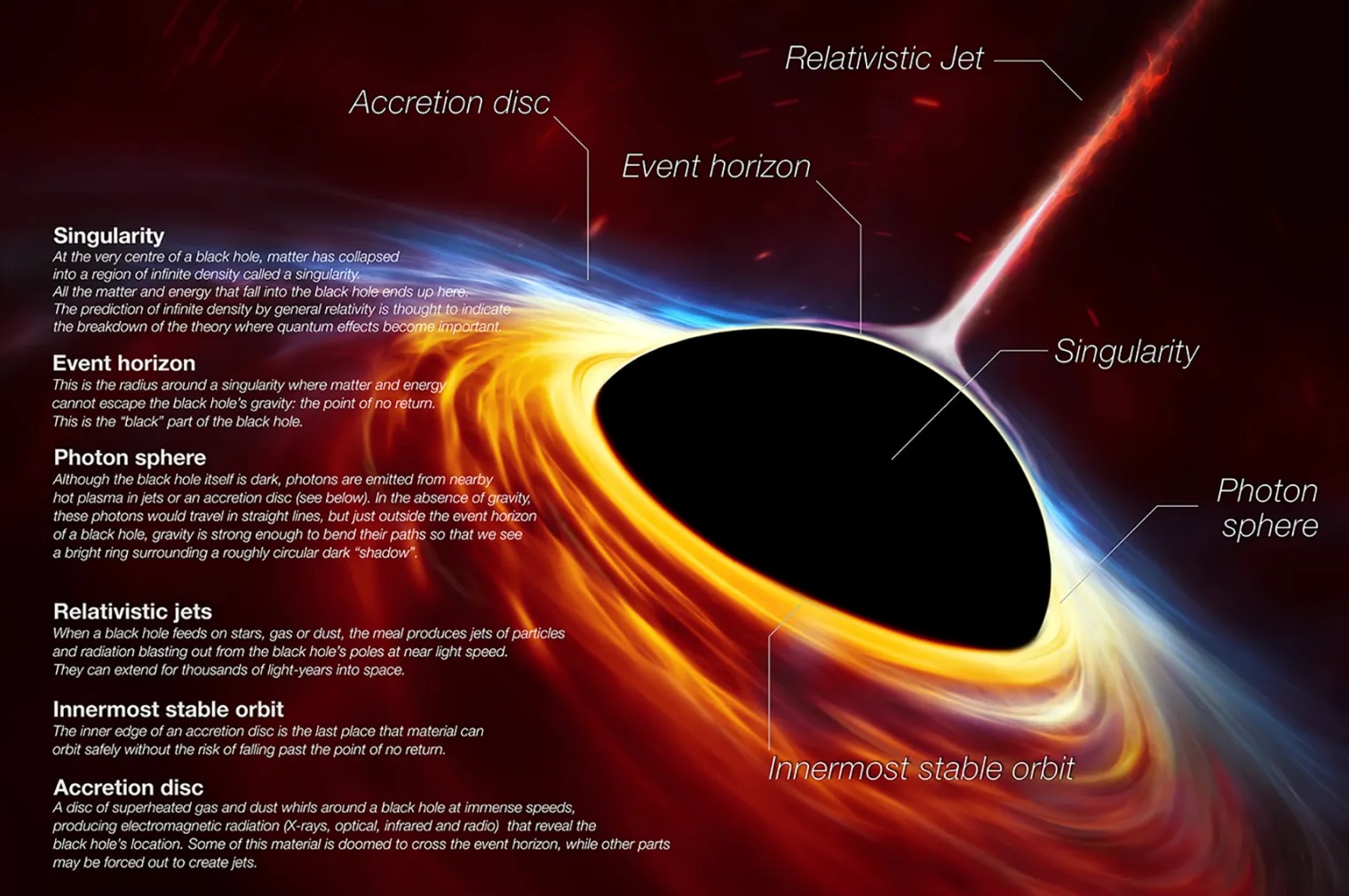
The event horizon acts as a 2D "quantum max" boundary, maximizing encoded information while the Planck sphere core remains finite and non-singular.